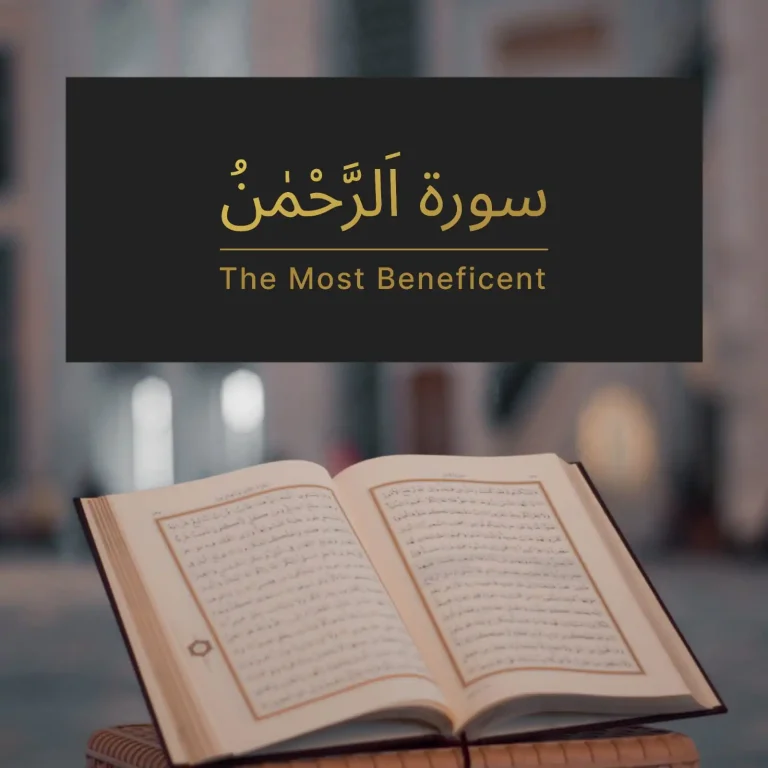
Complete Surah Ar-Rahman with Arabic text, Roman English transliteration, and English translation — all 78 ayahs for easy pronunciation and understanding.
Ar-Rahmaan
The Most Merciful
‘Allamal Qur’aan
Taught the Qur’an,
Khalaqal insaan
Created man,
‘Allamahul bayaan
[And] taught him eloquence.
Ash-shamsu wal qamaru bi husbaan
The sun and the moon [move] by precise calculation,
Wan-najmu wash-shajaru yasjudaan
And the stars and trees prostrate.
Was-samaaa’a rafa’ahaa wa wada’al meezaan
And the heaven He raised and imposed the balance
Allaa tatghaw fil meezaan
That you not transgress within the balance.
Wa aqeemul wazna bil qisti wa laa tukhsirul meezaan
And establish weight in justice and do not make deficient the balance.
Wal arda wada’ahaa lil anaam
And the earth He laid [out] for the creatures.
Feehaa faakihatunw wan nakhlu zaatul akmaam
Therein is fruit and palm trees having sheaths [of dates]
Wal habbu zul ‘asfi war raihaan
And grain having husks and scented plants.
Fabi ayyi aalaaa’i Rabbikumaa tukazzibaan
So which of the favors of your Lord would you deny?
Khalaqal insaana min salsaalin kal fakhkhaar
He created man from clay like [that of] pottery.
Wa khalaqal jaaan mim maarijim min naar
And He created the jinn from a smokeless flame of fire.
Fabi ayyi aalaaa’i Rabbikumaa tukazzibaan
So which of the favors of your Lord would you deny?
Rabbul mashriqayni wa Rabbul maghribain
[He is] Lord of the two sunrises and Lord of the two sunsets.
Fabi ayyi aalaaa’i Rabbikumaa tukazzibaan
So which of the favors of your Lord would you deny?
Marajal bahrayni yaltaqiyaan
He released the two seas, meeting [side by side];
Bainahumaa barzakhul laa yabghiyaan
Between them is a barrier [so] neither of them transgresses.
Fabi ayyi aalaaa’i Rabbikumaa tukazzibaan
So which of the favors of your Lord would you deny?
Yakhruju minhumal lu’lu’u wal marjaan
From both of them emerge pearl and coral.
Fabi ayyi aalaaa’i Rabbikumaa tukazzibaan
So which of the favors of your Lord would you deny?
Wa lahul jawaaril munsha’aatu fil bahri kal a’laam
And to Him belong the ships [with sails] elevated in the sea like mountains.
Fabi ayyi aalaaa’i Rabbikumaa tukazzibaan
So which of the favors of your Lord would you deny?
Kullu man ‘alaihaa faan
Everyone upon the earth will perish,
Wa yabqaa wajhu Rabbika zul jalaali wal ikraam
And there will remain the Face of your Lord, Owner of Majesty and Honor.
Fabi ayyi aalaaa’i Rabbikumaa tukazzibaan
So which of the favors of your Lord would you deny?
Yas’aluhoo man fis samaawaati wal ard; kulla yawmin huwa fee sha’n
Whoever is within the heavens and earth asks Him; every day He is bringing about a matter.
Fabi ayyi aalaaa’i Rabbikumaa tukazzibaan
So which of the favors of your Lord would you deny?
Sanafrughu lakum ayyuhas saqalaan
We will attend to you, O prominent beings.
Fabi ayyi aalaaa’i Rabbikumaa tukazzibaan
So which of the favors of your Lord would you deny?
Yaa ma’sharal jinni wal insi inis tata’tum an tanfuzoo min aqtaaris samaawaati wal ardi fanfuzoo; laa tanfuzoona illaa bisultaan
O company of jinn and mankind, if you are able to pass beyond the regions of the heavens and the earth, then pass. You will not pass except by authority [from Allah].
Fabi ayyi aalaaa’i Rabbikumaa tukazzibaan
So which of the favors of your Lord would you deny?
Yursalu ‘alaikumaa shuwaazum min naarifiw wa nuhaasun falaa tantasiraan
There will be sent upon you a flame of fire and smoke, and you will not defend yourselves.
Fabi ayyi aalaaa’i Rabbikumaa tukazzibaan
So which of the favors of your Lord would you deny?
Fa-izanshaq-qatis samaaa’u fakaanat wardatan kaddihaan
And when the heaven is split open and becomes rose-colored like oil —
Fabi ayyi aalaaa’i Rabbikumaa tukazzibaan
So which of the favors of your Lord would you deny?
Fa yawma’izil laa yus’alu ‘an zambiheee insunw wa laa jaann
Then on that Day none will be asked about his sin among men or jinn.
Fabi ayyi aalaaa’i Rabbikumaa tukazzibaan
So which of the favors of your Lord would you deny?
Yu’raful mujrimoona bi seemaahum fa yu’khazu bin nawaasi wal aqdaam
The criminals will be known by their marks, and they will be seized by the forelocks and the feet.
Fabi ayyi aalaaa’i Rabbikumaa tukazzibaan
So which of the favors of your Lord would you deny?
Haazihee jahannamul latee yukazzibu bihal mujrimoon
This is Hell, which the criminals deny.
Yatoofoona bainahaa wa baina hameemim aan
They will go around between it and scalding water, heated [to the utmost degree].
Fabi ayyi aalaaa’i Rabbikumaa tukazzibaan
So which of the favors of your Lord would you deny?
Wa liman khaafa maqaama Rabbihee jannataan
But for he who has feared the position of his Lord are two gardens —
Fabi ayyi aalaaa’i Rabbikumaa tukazzibaan
So which of the favors of your Lord would you deny?
Zawaataaa afnaan
Having [spreading] branches.
Fabi ayyi aalaaa’i Rabbikumaa tukazzibaan
So which of the favors of your Lord would you deny?
Feehimaa ‘aynaani tajriyaan
In both of them are two springs, flowing.
Fabi ayyi aalaaa’i Rabbikumaa tukazzibaan
So which of the favors of your Lord would you deny?
Feehimaa min kulli faakihatin zawjaan
In both of them are of every fruit, two kinds.
Fabi ayyi aalaaa’i Rabbikumaa tukazzibaan
So which of the favors of your Lord would you deny?
Muttaki’eena ‘alaa furushim bataaa’inuhaa min istabraq; wa janal jannataini daan
[They are] reclining on beds whose linings are of silk brocade, and the fruit of the two gardens is hanging low.
Fabi ayyi aalaaa’i Rabbikumaa tukazzibaan
So which of the favors of your Lord would you deny?
Feehinna qaasiraatut tarfi lam yatmishunna insun qablahum wa laa jaann
In them are women limiting [their] glances, untouched before them by man or jinni —
Fabi ayyi aalaaa’i Rabbikumaa tukazzibaan
So which of the favors of your Lord would you deny?
Ka annahunnal yaaqootu wal marjaan
As if they were rubies and coral.
Fabi ayyi aalaaa’i Rabbikumaa tukazzibaan
So which of the favors of your Lord would you deny?
Hal jazaaa’ul ihsaani illal ihsaan
Is the reward for good [anything] but good?
Fabi ayyi aalaaa’i Rabbikumaa tukazzibaan
So which of the favors of your Lord would you deny?
Wa min doonihimaa jannataan
And below them both [in excellence] are two [other] gardens —
Fabi ayyi aalaaa’i Rabbikumaa tukazzibaan
So which of the favors of your Lord would you deny?
Mudhaaammataaan
Dark green [in color].
Fabi ayyi aalaaa’i Rabbikumaa tukazzibaan
So which of the favors of your Lord would you deny?
Feehimaa ‘aynaani naddaakhataan
In both of them are two springs, spouting.
Fabi ayyi aalaaa’i Rabbikumaa tukazzibaan
So which of the favors of your Lord would you deny?
Feehimaa faakihatunw wa nakhlunw wa rummaan
In both of them are fruit and palm trees and pomegranates.
Fabi ayyi aalaaa’i Rabbikumaa tukazzibaan
So which of the favors of your Lord would you deny?
Feehinna khairaatun hisaan
In them are good and beautiful women —
Fabi ayyi aalaaa’i Rabbikumaa tukazzibaan
So which of the favors of your Lord would you deny?
Hoorum maqsooraatun fil khiyaam
Fair ones reserved in pavilions —
Fabi ayyi aalaaa’i Rabbikumaa tukazzibaan
So which of the favors of your Lord would you deny?
Lam yatmis hunna insun qablahum wa laa jaann
Untouched before them by man or jinni —
Fabi ayyi aalaaa’i Rabbikumaa tukazzibaan
So which of the favors of your Lord would you deny?
Muttaki’eena ‘alaa rafratin khudrinw wa ‘abqariyyin hisaan
Reclining on green cushions and beautiful fine carpets.
Fabi ayyi aalaaa’i Rabbikumaa tukazzibaan
So which of the favors of your Lord would you deny?
Tabaarakasmu Rabbika Zil Jalaali wal Ikraam
Blessed is the name of your Lord, Owner of Majesty and Honor.
Introduction
Surah Ar-Rahman, the 55th chapter of the Holy Quran, holds a special place in the hearts of Muslims around the world. Known as “The Beauty of the Quran,” its rhythmic verses and powerful refrain make it one of the most beloved chapters to recite and listen to. This page presents the complete Surah Rahman in Roman English — a phonetic transliteration using the English alphabet — alongside the original Arabic script and English translation of every ayah.
For millions of Muslims who grew up reading Roman Urdu or who are more comfortable with the Latin script, accessing the Quran through transliteration opens a door that might otherwise remain closed. Whether you are a new Muslim, a young learner, or someone who simply hasn’t had the chance to study Arabic, this format lets you recite the words of Allah with confidence. You can also follow along while listening to the beautiful recitation by Abdul Basit Abdul Samad, which is one of the most effective ways to improve your pronunciation.
Each ayah above includes three layers: the Arabic text for reference, the English transliteration for pronunciation, and the Sahih International translation for understanding. Together, they give you a complete picture — how the words look, how they sound, and what they mean. If you would like a printable copy for daily practice, you can also download the Surah Rahman PDF.
A note on transliteration: Roman English is a pronunciation aid and should not be considered a replacement for learning to read the original Arabic Quran. Certain Arabic sounds — such as ع (Ain), ق (Qaf), and ح (Ha) — have no exact English equivalent. We encourage every reader to treat this as a stepping stone toward mastering the Arabic script and proper Tajweed.
About Surah Rahman
Surah Ar-Rahman consists of 78 ayahs and was revealed in Madinah. It is named after one of the most beautiful names of Allah — Ar-Rahman, meaning “The Most Merciful.” The chapter addresses both mankind and Jinn, repeatedly asking the powerful question: “So which of the favors of your Lord would you deny?” This refrain appears 31 times, creating a rhythmic cadence that moves the heart and compels reflection.
The Surah paints a vivid picture of Allah’s creation — the sun and moon moving by calculation, the stars and trees prostrating, the seas held apart by an invisible barrier. It then shifts to scenes of the Day of Judgment before describing the gardens of Jannah (Paradise) in stunning detail. Readers who wish to explore the meaning more deeply can read the Surah Rahman with Urdu Translation or the Hindi translation for further insight.
Why Read Surah Rahman in Roman English?
Learning Arabic takes time. For someone eager to begin reciting the Quran today, transliteration bridges that gap immediately. It converts the Arabic sounds into Latin letters you already know how to read, so you can start practicing without waiting months or years to learn a new script.
There is also a practical benefit: when you recite the transliterated text repeatedly, your tongue grows familiar with Arabic phonetics. This muscle memory makes the eventual transition to reading Arabic noticeably easier. Many learners report that after weeks of consistent practice with the Roman English text, they begin recognizing Arabic words naturally.
Who Should Read Roman English?
This format serves a wide range of readers:
- New Muslims who want to start reciting the Quran immediately without waiting to learn Arabic.
- South Asian diaspora communities accustomed to Roman Urdu — reading Urdu words written in the English alphabet.
- Students working on memorization who find it helpful to read the phonetic text alongside the Arabic.
- Anyone following along with audio recitations — pairing transliteration with a reciter’s voice is one of the fastest ways to develop accurate pronunciation.
Difference Between Transliteration and Translation
These two terms often get confused, but they serve completely different purposes. Transliteration shows you how to say the Arabic words using English letters. Translation tells you what those words mean in English.
Take the first ayah as an example: the transliteration is “Ar-Rahmaan” — that tells you how to pronounce it. The translation is “The Most Merciful” — that tells you what it means. On this page, we provide both, so you get the full experience: correct pronunciation alongside deep understanding. For additional Quranic study, you may also want to read Ayatul Kursi, one of the most widely recited verses for daily protection.
How Roman English Improves Pronunciation
Arabic script can feel intimidating at first glance — it reads right-to-left, the letters change shape depending on position, and many sounds have no equivalent in English. Transliteration breaks through that complexity by mapping Arabic phonetics into letters you already recognize.
The key is to read slowly and deliberately. When you see “Fabi ayyi aalaaa’i Rabbikumaa tukazzibaan,” break it into syllables: Fa-bi ay-yi aa-laa-i Rab-bi-ku-maa tu-kaz-zi-baan. Once you can sound out each syllable, your confidence grows rapidly. Pair this practice with listening to a skilled reciter, and you will notice your pronunciation sharpening within days.
Benefits of Reading Surah Rahman
This chapter is a profound reminder of the countless blessings we often overlook — from the food we eat, to the balance of the cosmos, to the very faculty of speech. Reciting it regularly softens the heart and cultivates a deep sense of gratitude. Many Muslims include it in their daily or weekly recitation routine for the spiritual tranquility it brings.
Reflecting on its themes — the Mercy of Allah, the signs in creation, the accountability of the Hereafter, the rewards of Paradise — strengthens one’s relationship with the Creator and provides perspective during difficult times.
Tips for Learning Pronunciation
To get the most out of this transliteration:
- Listen first, then read: Play a high-quality recitation and follow along with the text. This trains your ear before you train your tongue.
- Go slowly: Rushing through the words defeats the purpose. Give each syllable its proper weight.
- Pause for meaning: After every few ayahs, read the English translation to stay connected with the message.
- Be consistent: Even 10 minutes of daily practice produces better results than an hour once a week.
- Record yourself: Listening to your own recitation helps you spot areas that need improvement.
Frequently Asked Questions
What is Surah Rahman in Roman English?
It is the phonetic representation of the original Arabic text using the English alphabet. This allows anyone who cannot read Arabic script to pronounce and recite the verses of Surah Ar-Rahman correctly.
Is Roman English the same as translation?
No. Transliteration shows you how to pronounce the Arabic words, while a translation conveys the meaning in English. Both serve different purposes and work best when used together.
Can I learn Quran pronunciation using Roman English?
Yes. When combined with listening to a qualified reciter, transliteration is highly effective for improving pronunciation and developing a basic sense of Tajweed rules.
Can beginners read Surah Rahman using transliteration?
Absolutely. The format converts complex Arabic phonetics into readable English characters, making it accessible for complete beginners to start reciting right away.
How accurate is Roman English?
It is highly accurate for standard pronunciation. However, certain Arabic sounds like Ain and Qaf have no exact English equivalent. Transliteration is an excellent starting point, but learning the original Arabic script is always recommended for complete accuracy.
Is Roman English suitable for memorization?
Yes. Many learners use transliteration to build fluency and memorize Surahs before transitioning to reading directly from the Arabic text.
Related Reading
If you would like to continue your Quranic journey beyond this page, here are some resources we have curated for you. Those who understand Urdu may find additional clarity by reading the Surah Rahman with Urdu Translation, while Hindi-speaking readers can explore the Surah Rahman Translation in Hindi.
French readers may also appreciate our page on Ayat al-Kursi – Le Verset du Trône, which provides Ayatul Kursi in French with full explanation.
May Allah accept your efforts in learning and reciting His Book, and may this page serve as a small step on a lifelong journey of understanding the Holy Quran.